Learning methods
When does human help teach a robot, and when is it part of a test?
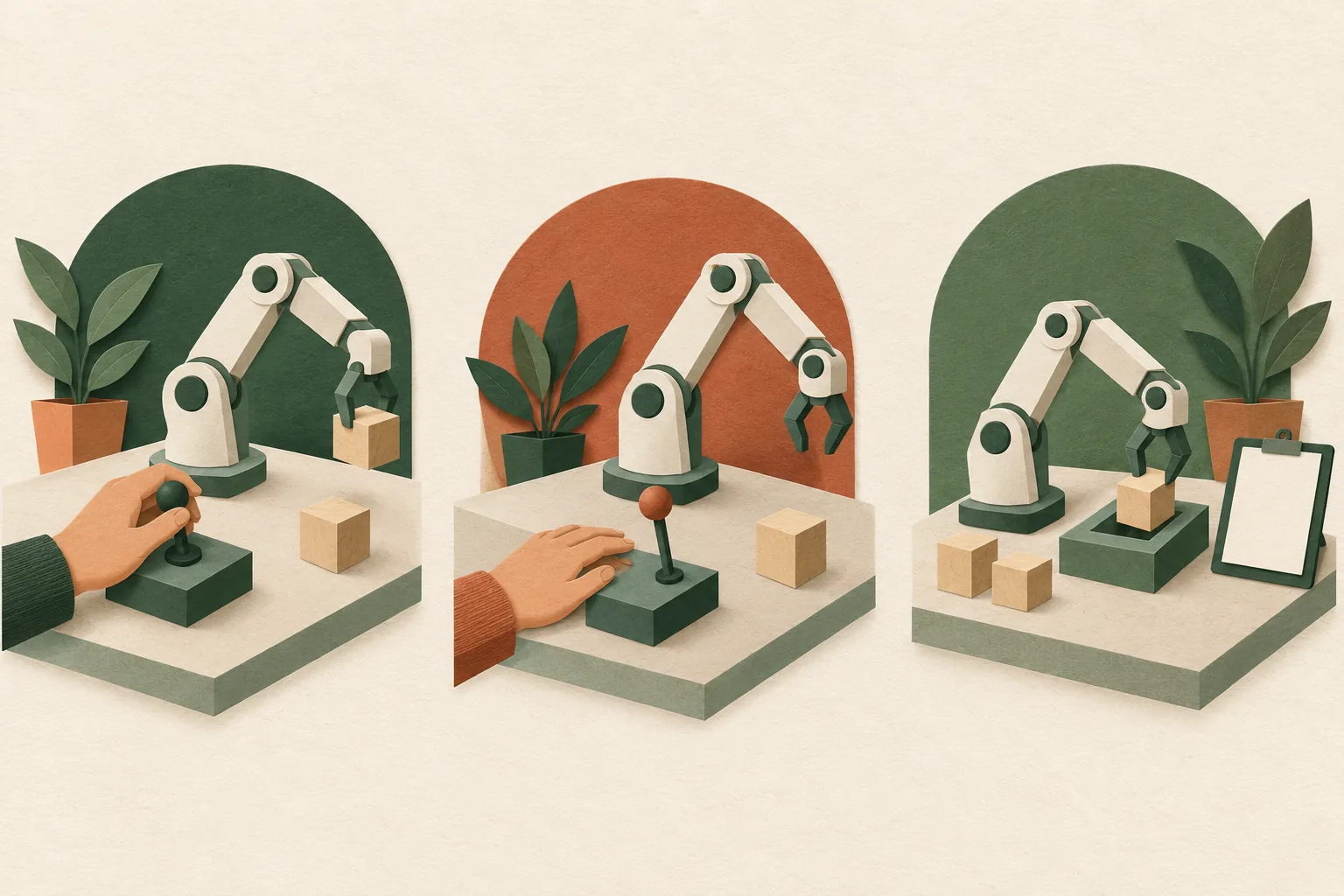
Demonstrations, corrections and evaluation episodes answer different questions. Follow who controls the movement and how the recorded information is used.
Ask who controls the movement, what information is retained, and whether the episode is being used to teach or to test.
A demonstration supplies an example
In the LeRobot tutorial, a person teleoperates the robot and records trajectories. A neural network is then trained to imitate those trajectories before the trained model is deployed. The person's movement supplies examples for learning; it does not itself show how the learned controller performs.
A takeover can change training
Bee's authors describe a human monitoring online training and taking over when the robot appears headed for a failure it cannot recover from. Bee uses those interventions to train a separate correction model.
Read the training and evaluation measures separately
Bee defines its intervention rate using the share of control steps taken over during online training. Its task evaluations use separate rounds of trials. A training intervention measure therefore describes a different part of the study from an evaluation result. It should be read with its stated phase attached.
For another robot report, we recommend noting the operator's role and the episode's purpose beside each result before comparing numbers. Look for whether human input creates examples, corrects training attempts, or occurs during a reported test. If that role is unstated, leave it as an open question. LeRobot and Bee illustrate distinctions to look for; they do not establish a required sequence for every learning system.