Learning methods
From Guided Play to Autonomous Dexterous Practice
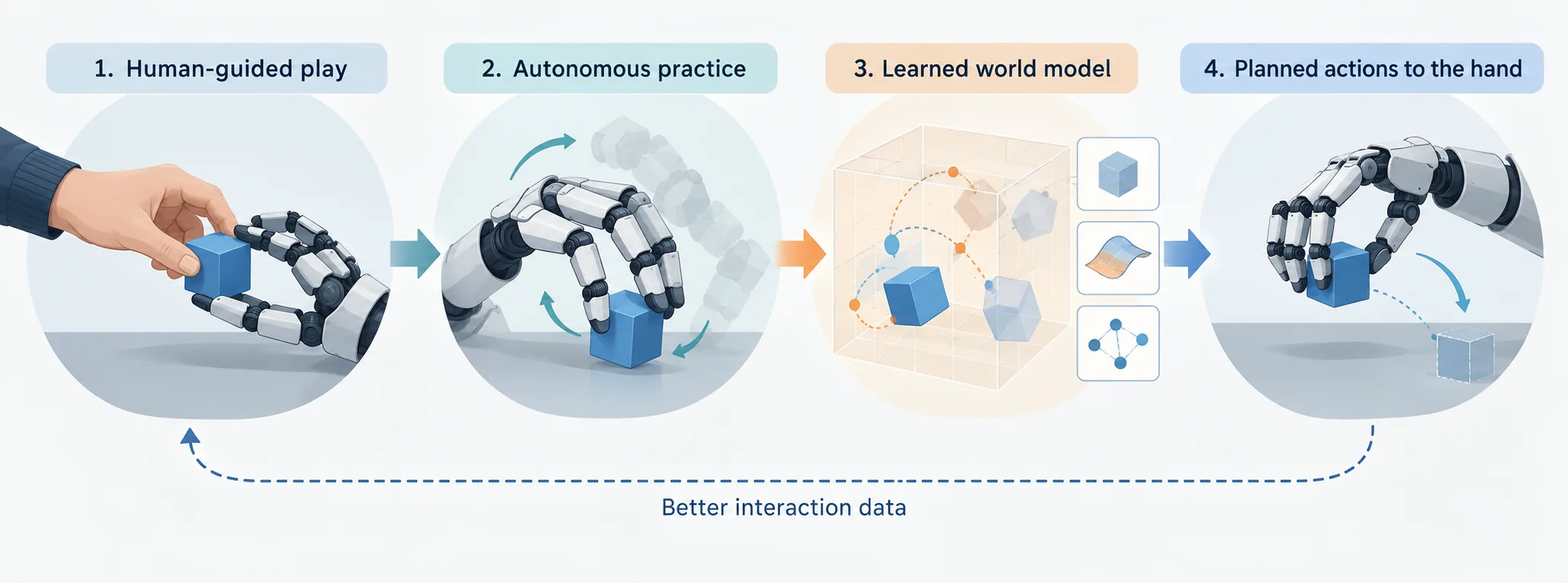
DSP converts a short human play session into autonomous practice, then reuses the collected interactions for model-based planning and policy training.
A preprint submitted on October 15, 2026 describes Dexterity from Supervised Play (DSP), a framework that uses brief human input to bootstrap much longer periods of robot practice. In DSP, a few minutes of human-guided play become a behavior-cloned play policy that the robot can run autonomously for hours, generating the interaction data used to learn a world model.
The learned components support dexterous control through model-predictive control and goal-conditioned policy distillation. During model-predictive control, the play policy proposes candidate action sequences for evaluation under the learned world model. The authors also introduce self-play within the learned world model to distill a closed-loop, goal-conditioned policy as a way to accelerate inference.
The authors evaluated the framework on underactuated pushing and any-to-any in-hand pose reorientation with a multifingered hand, in simulation and the real world. For the real-world experiment, they report a 69.6% success-rate advantage over hindsight behavior cloning and success comparable to reinforcement learning with 490 times less interaction data. They argue that play learned from human guidance can gather its own training interactions, support planning with a learned model, and train a policy, all without demonstrations tailored to a particular task or a simulation-to-reality step.