Research updates
Can human corrections teach a robot more than imitation?
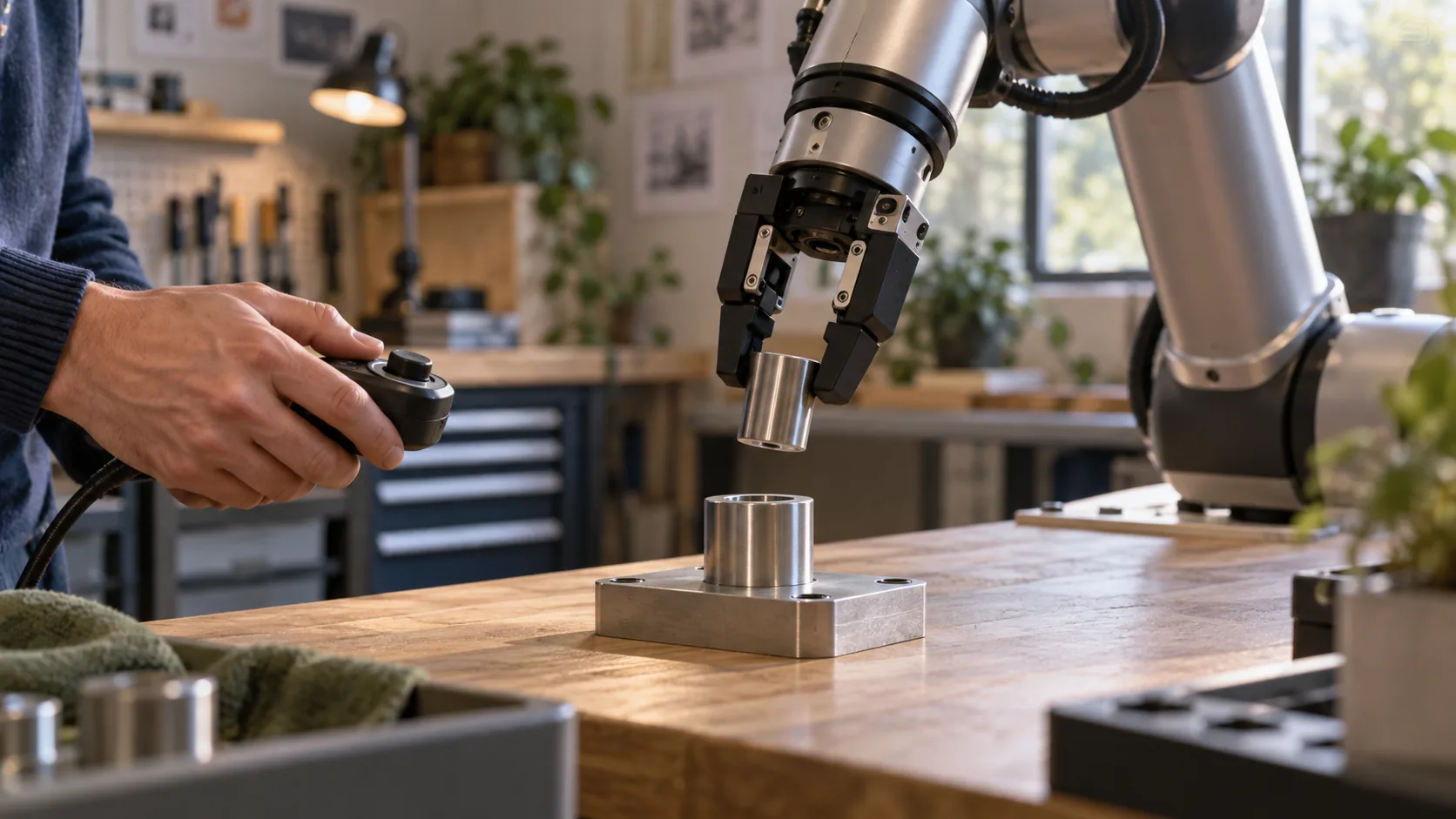
In Bee, a person can take over when a robot is about to fail during online training. The researchers use those interventions to predict which action adjustments are consistent and to constrain a policy trained on top of a frozen vision-language-action model. The study tests the idea on three physical tasks and one simulated task.
How does the correction change learning?
The authors first adapt a vision-language-action model to each task and then freeze it. That model supplies an action proposal; a separate policy can refine it. During training, an operator takes control when a failure appears imminent and unlikely to be recovered without help. The system retains both the model's proposal and the action the operator took.
Bee does not use those interventions only as actions to copy. Its correction model predicts an adjustment to a proposal and how consistent such corrections are along each action dimension. Where they are consistent, the later policy is constrained to stay closer to the predicted corrected action. Where they vary, the constraint relaxes. This lets reinforcement learning refine the policy while using the pattern in the human corrections.
What did the researchers test?
In the Bee preprint, the authors report three physical manipulation tasks: phone charging, snack hanging and cloth aligning. Bowl placing ran in LIBERO-Pro simulation. The authors report Bee as having the highest success rate on each of these tasks among the methods in their study. Each task had three evaluation rounds of 20 trials.
The success rules matter. Phone charging and cloth aligning were scored on a precision-critical phase, while snack hanging and bowl placing were scored on the full task. All methods started from a vision-language-action model already adapted separately to each task. The reported comparison therefore concerns these tasks, models and success rules.
What does human involvement measure?
The paper's intervention rate counts the proportion of control steps taken over by a person during online training. Its success rate comes from evaluation trials. For Bee's central question, the first measure records human input to training, while the second tests the resulting policy in evaluation.