Research updates
RLHND Extracts Hand Motion and Touch Estimates From a Single Video View
The proposed system reuses a video diffusion backbone, adds dedicated pose and tactile streams, and reports retargeting and physical-robot tests, although the available abstract provides no numerical results.
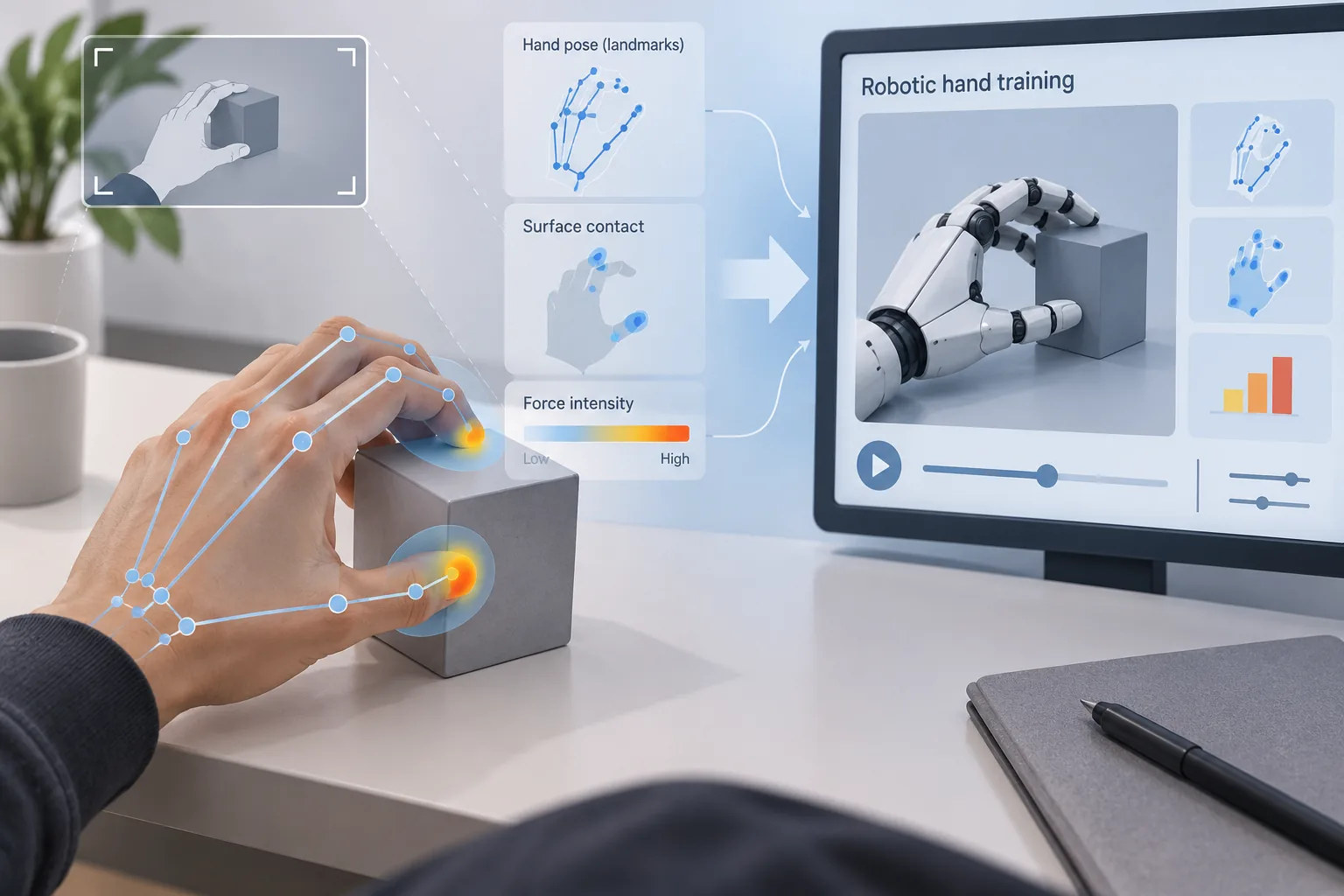
RLHND estimates both kinds of signal by turning a pretrained Cosmos 3 video diffusion backbone into a deterministic clip-level feature extractor, then using separate pose and tactile streams to predict anatomically constrained hand configurations and dense contact and force over the hand surface. Its input is monocular egocentric video: first-person clips captured from a single camera viewpoint.
The authors use a process they call clean-latent conditioning to make the generative video backbone operate as a deterministic extractor for an entire clip. Their stated aim is to carry the backbone’s learned priors about hand motion and hand-object interaction into tracking. The pose stream predicts joint angles intended to remain anatomically plausible. An optional shape parameter can keep the estimated hand shape consistent within one video or across videos featuring the same person.
For touch estimation, the method freezes the pose stream and trains a separate tactile expert to infer contact and force densely across the hand surface. It also spreads features to individual surface vertices with an LBS-based method, avoiding the more expensive alternative of applying attention separately at every vertex. These contact and force maps are model estimates derived from video, not tactile-sensor measurements.
The preprint authors report state-of-the-art results for pose, contact and force estimation across several benchmark datasets. They also report retargeting results and physical-robot experiments as evidence that the recovered signals can support robot learning. The admitted evidence is the authors’ abstract, which does not provide benchmark names, numerical metrics, task descriptions or robot success rates, so those comparative and real-world claims cannot be evaluated here or treated as independent confirmation. The supported conclusion is narrower: RLHND presents a clip-level route from single-view human video to estimated pose and tactile training signals, while the strength of its reported performance still requires examination of the full experiments.