Skills and applications
DexGraspFlow Makes Hand Structure Part of Grasp Generation
The proposed system combines object and link geometry with distances through each hand’s kinematic tree, then turns generated link poses into joint configurations.
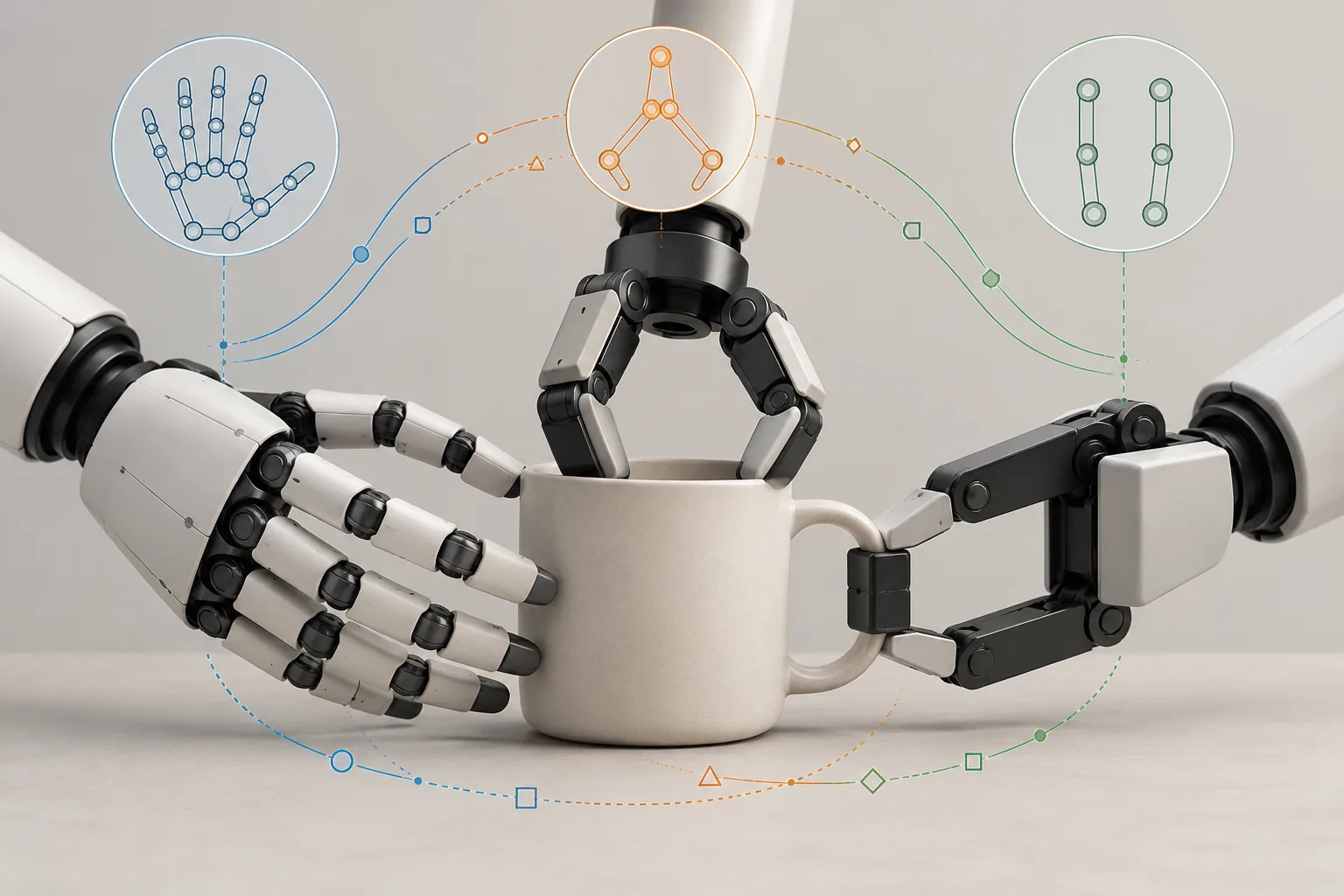
Differences in hand geometry, joint parameterization and kinematic topology make cross-embodiment dexterous grasp generation challenging. The authors of the DexGraspFlow preprint address this by representing each hand at the link level and explicitly supplying the model with information about that tree.
DexGraspFlow handles different hand topologies by generating a pose for each link while using kinematic-tree distances to tell its attention mechanism how those links are structurally related. For every link, the input describes nearby object shape, the link’s own shape and its present pose. The architecture uses one stream to reason about coordination among hand links and another to connect the links with the object. It turns distances along the hand’s kinematic tree into attention biases, allowing the network to account for structural relationships as the geometry evolves.
The model jointly learns translational and rotational velocity fields in SE(3). Integrating those fields produces target link poses; inverse kinematics converts the poses into the hand’s joint configuration. At inference time, additional palm-orientation guidance can steer the generated grasp without retraining the model.
The authors report a 95.33% average simulation success rate across three robotic hands and 30 object–hand pairs. They also report that generation, including inverse kinematics, had approximately 49% lower average latency than a state-of-the-art baseline. These are results from the authors’ simulation experiments, not independent confirmation.
The authors report zero-shot adaptability in experiments on seven finger-removal variants. The available evidence does not provide a separate numerical success rate for those variants.
Physical execution was evaluated more narrowly: a model trained on demonstrations for the deployed hand achieved a 91% success rate in 100 real-robot grasping trials. That experiment supports grasp execution on one trained hand, but it does not by itself establish zero-shot physical transfer across different hand topologies. The central cross-embodiment evidence remains the reported multi-hand simulation and finger-removal evaluation.