Skills and applications
Uni-PNP: Unified Prehensile and Non-prehensile Policy Learning
Uni-PNP pairs simulated contact-dynamics pretraining with a reinforcement-learning curriculum designed to discover coordinated routes to a target object pose.
The authors report that existing approaches typically develop prehensile and non-prehensile capabilities separately, then integrate them by sequencing distinct primitives through prescribed intermediate objectives, limiting coordination between contact motions and grasping. They also report that this integration remains sensitive to object and gripper geometry and depends on particular environmental supports.
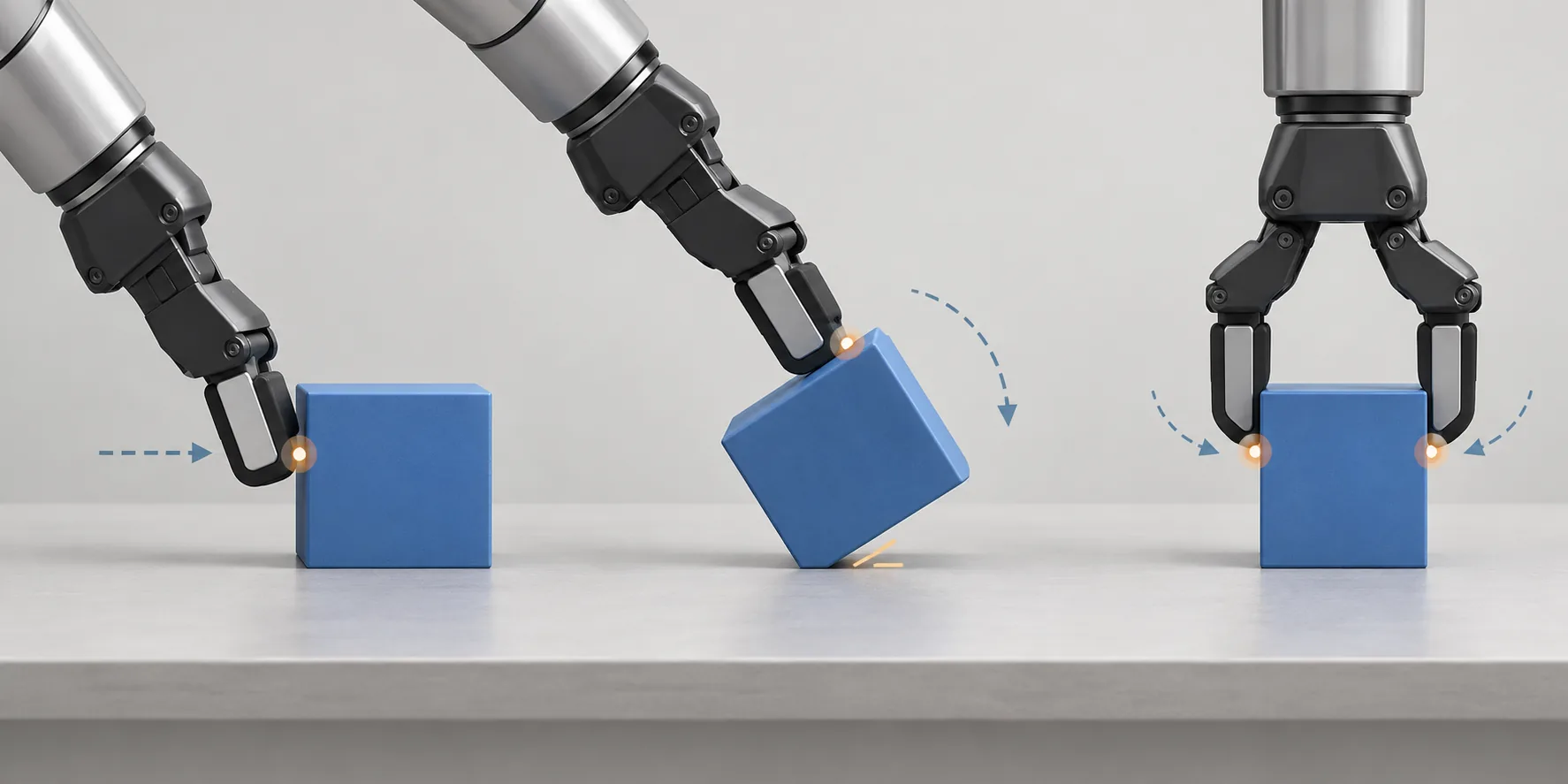
Uni-PNP combines these actions by first pretraining a geometry encoder to predict contact-induced object motion, then training a single policy through a two-stage reinforcement-learning curriculum that moves from graspable objects to ungraspable peers. The encoder learns from a contact-dynamics dataset built with simulated interactions between diverse objects and grippers. The curriculum is intended to encourage the policy to discover non-prehensile interactions and integrate them with grasping rather than follow a prescribed sequence of separate primitives.
In their analysis, the researchers report behaviors that include repositioning both without and with a grasp, acquiring a grasp after tipping an object, and reorienting a held object with help from a table. These examples show how the learned policy can coordinate contact motions around the shared goal of reaching a target object pose.
Across hundreds of seen objects with grippers, the authors report a 76.39% success rate, compared with 57.91% on unseen peers. Those results exceed the strongest pose-reaching baseline evaluated by the authors by 20.52 and 17.79 percentage points, respectively. The preprint also reports transfer to a real-world scenario, but its abstract gives no tasks, trial counts or success rate for that transfer, so the physical result remains a limited author claim rather than independent confirmation.