Skills and applications
How Unequal Robot Fingers Become Both Feet and Tools
A preprint details how simulation-trained control, onboard hardware and task-specific policies let an anthropomorphic hand support itself, travel, recover and interact with its surroundings.
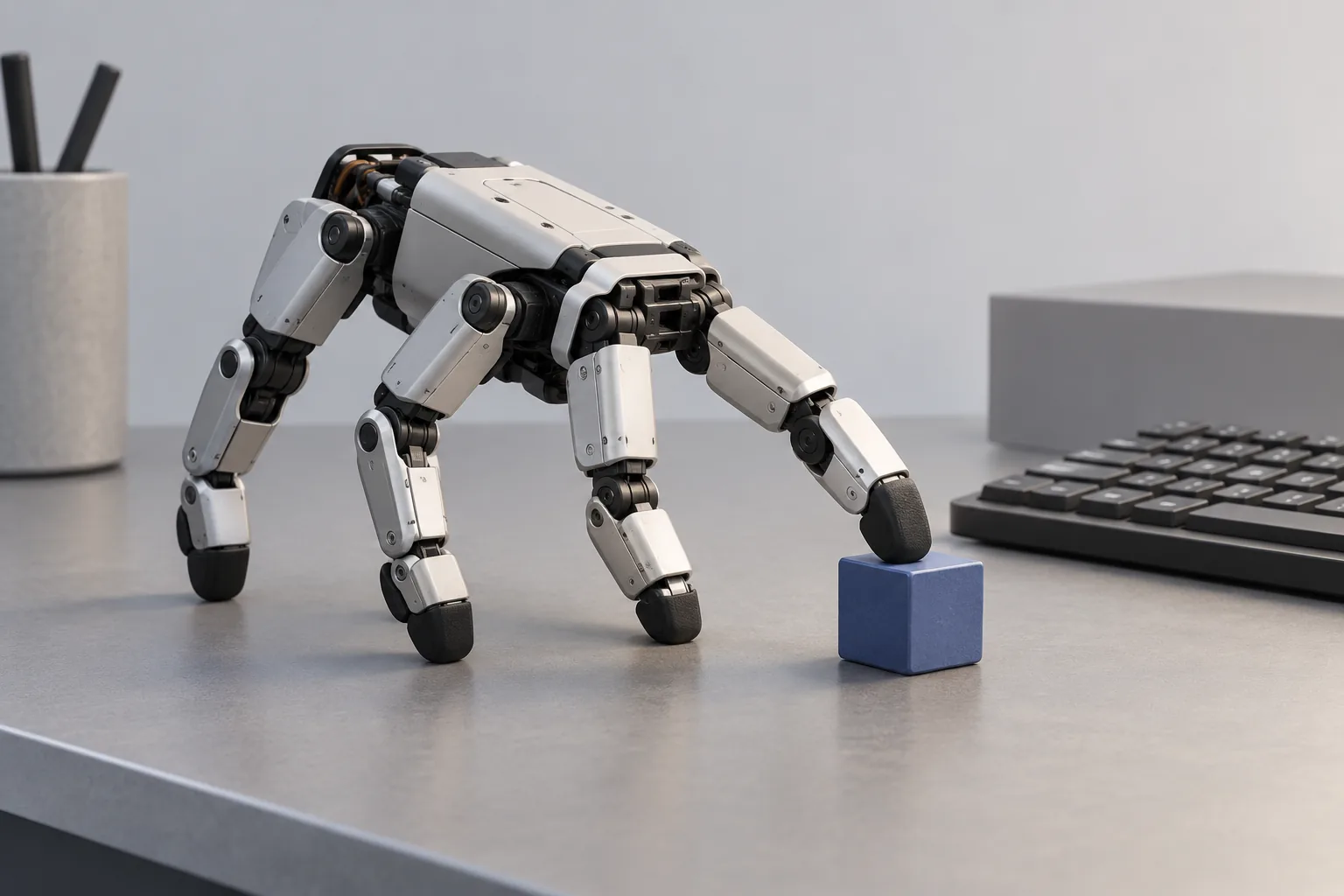
An anthropomorphic hand can coordinate its unequal fingers through reinforcement learning so that they bear its weight and propel it, while those same digits still carry out keyboard and object-pushing tasks.
The preprint’s authors kept the hand’s existing finger design and position controller. Their learning method accounts for the unequal fingers and trains in a simulator calibrated with hardware measurements. In simulation, they report that their reward formulation made the hand move faster than tuned rewards originally designed for quadrupeds; the abstract provides no numerical comparison, and this particular result is simulated rather than a hardware measurement.
On the physical platform, onboard power and computation allowed task-specific policies to produce untethered crawling, steering and fall recovery, the authors report. While supporting itself, the hand also executed successive keyboard commands without vision and pushed an object toward targets using overhead visual feedback. These demonstrations present the hand as a compact mobile manipulator that needs no separate locomotion mechanism, but the available evidence is the authors’ account in a single preprint rather than independent confirmation.