Simulation to reality
Inside SimVLA’s Simulation-Only Route to Mobile Manipulation
The framework layers synthetic skill trajectories, privileged-state visual-language supervision and simulated policy rollouts before its authors test direct transfer to physical mobile-manipulation tasks.
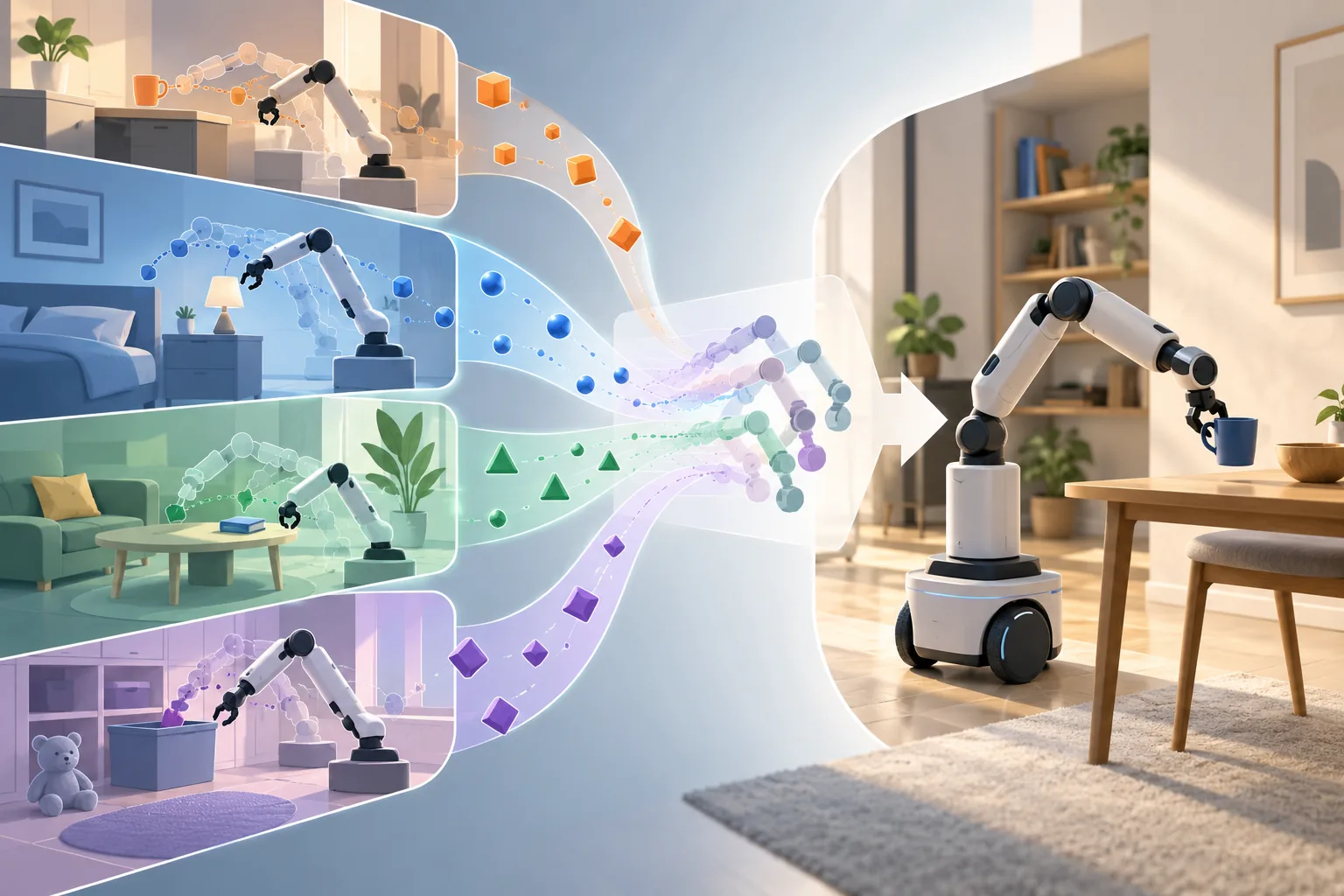
SimVLA trains a mobile-manipulation vision-language-action model entirely on synthetic simulation data without teleoperation: it pre-trains on SimAction robot trajectories and SimVQA visual-language supervision, then post-trains on a mixture of SimAction and SimDeploy policy rollouts.
Pre-training draws on two complementary datasets. SimAction provides robot actions across 35 diverse mobile-manipulation tasks, with trajectories generated by composing atomic skills. SimVQA uses privileged simulator state to produce spatial, geometric and subtask-level visual-language supervision. Together, they give the model both action examples and structured information about simulated scenes and tasks.
For post-training, the framework mixes SimAction with SimDeploy, a dataset collected from policy rollouts across diverse simulated environments. The authors describe the full training process as using synthetic simulation data without teleoperation, so real-world demonstrations are not part of this training pipeline.
The preprint authors report evaluating SimVLA on restocking, pouring and cleaning, with zero-shot transfer to physical mobile manipulation in settings that include real homes. They also say it outperforms policies trained on 50 in-domain real-world demonstrations. These remain author-reported results: the available abstract supplies neither task-by-task success rates nor the comparison protocol or uncertainty, and the evidence packet contains no independent confirmation. It therefore supports the proposed training recipe and the reported existence of real-world transfer, but not a detailed assessment of its magnitude or robustness.