Embodied AI models
One Robot Policy Can Learn to Interpret Different Controllers
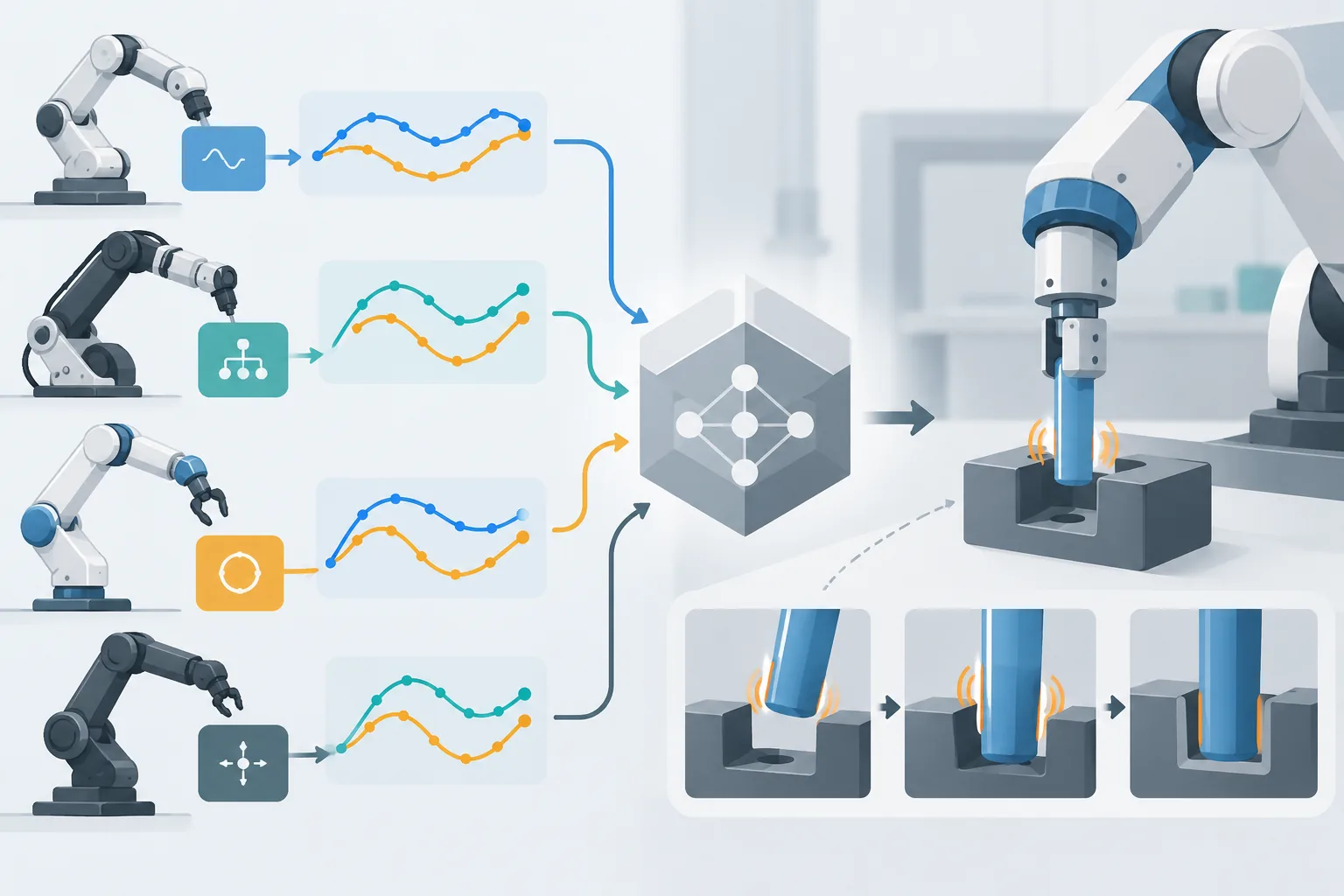
Action-and-motion examples give a transformer the context needed to interpret controller-specific behavior, with the authors reporting gains in real-world tests.
The preprint’s authors say that different controllers can assign different physical meanings to the same action and may require different strategies to complete a task.
The proposed framework encodes examples pairing commanded actions with resulting robot motions, and a transformer context encoder summarizes those interactions so a single policy can adapt in context. The study covers six controller types, along with variations in controller gains and compliance. For contact-rich tasks including USB insertion and surface wiping, the authors report that this context allowed the policy to change both its actions and its strategy.
Across their real-world experiments, the researchers report a 33-percentage-point improvement in average success over naive data pooling. They also report 50% success on controller modes not seen during training and 52% on unseen controller gains, as well as transfer to tasks with limited controller-specific data.
These results suggest that controller experience can be shared without assuming that identical action values have identical physical meanings. The available evidence, however, is a single preprint abstract: it provides no independent confirmation or detailed experimental audit, so the reported performance should be read as the authors’ result rather than an established general capability.