Embodied AI models
How Optical Flow Lets Evo-World Learn What Moves Next
The preprint trains a VLA on task-relevant future motion, then separates representation learning from action optimization to preserve that predictive signal.
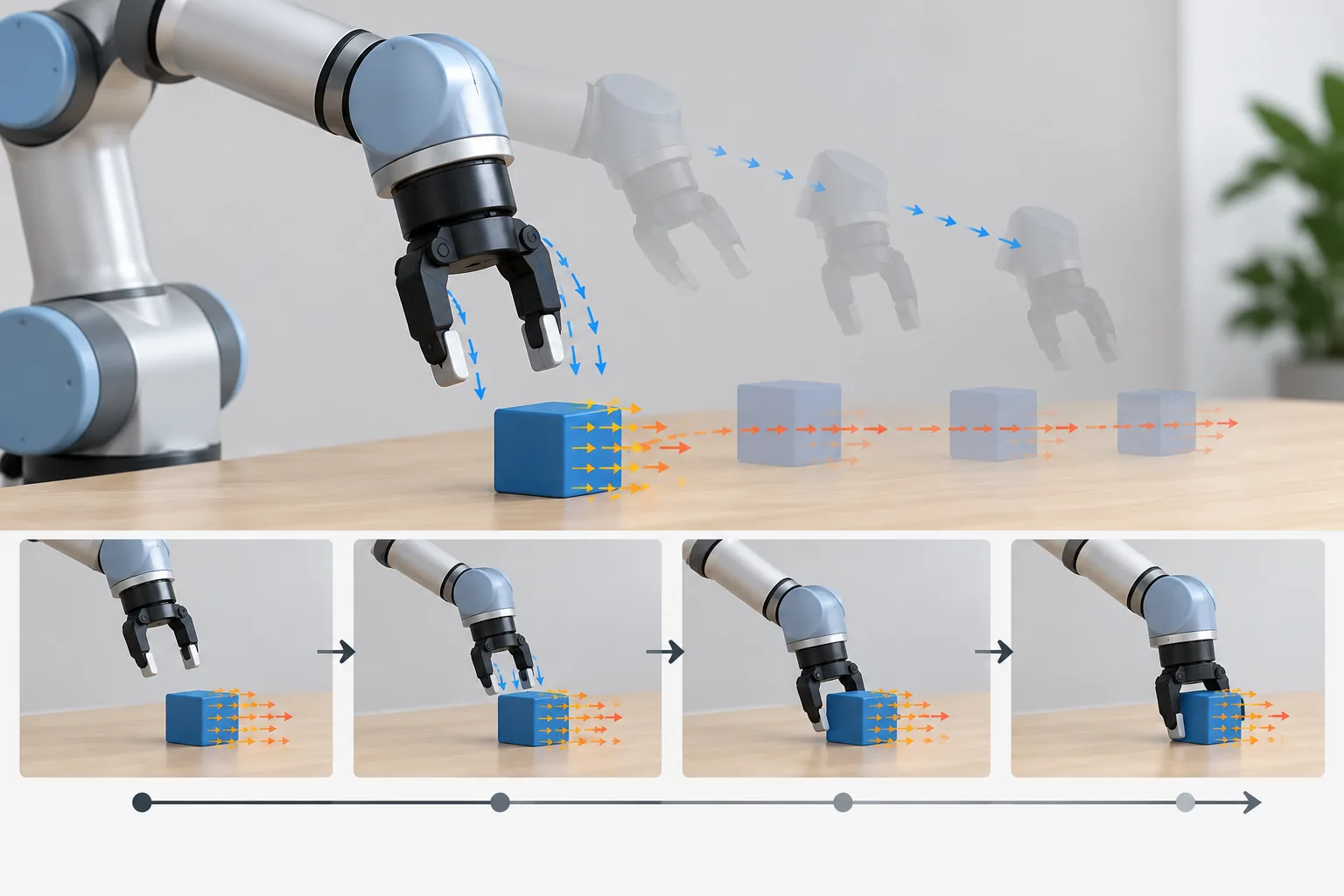
Instead of asking its vision-language-action model to reproduce an entire future scene, Evo-World uses optical flow as supervision for anticipated motion. Optical-flow supervision gives Evo-World a training target centered on how the scene is expected to move, so the model can learn predictive representations without reconstructing the scene’s largely static appearance. The authors argue that this distinction avoids mixing task-relevant motion with largely static visual content, while action supervision alone does not explicitly encourage anticipation.
The authors say their training procedure preserves these predictive representations during policy learning by regulating representation diversity and decoupling representation learning from action optimization. The available abstract identifies those design principles but does not provide enough implementation detail to establish how each one is applied.
On the Meta-World MT50 simulation benchmark, the researchers report a tier-averaged success rate of 91.1% and a 13.0% relative improvement over their non-predictive baseline. They also report that Evo-World outperformed the evaluated baselines on single-arm and bimanual manipulation tasks using real AgileX robots, while containing 0.87B parameters and requiring less GPU memory with higher inference efficiency. The abstract supplies no exact memory, inference, or physical-task success figures, so these remain author-reported results from one preprint rather than independent confirmation.