Embodied AI models
Inside SERA’s Self-Evolving Harness for History-Dependent Robot Tasks
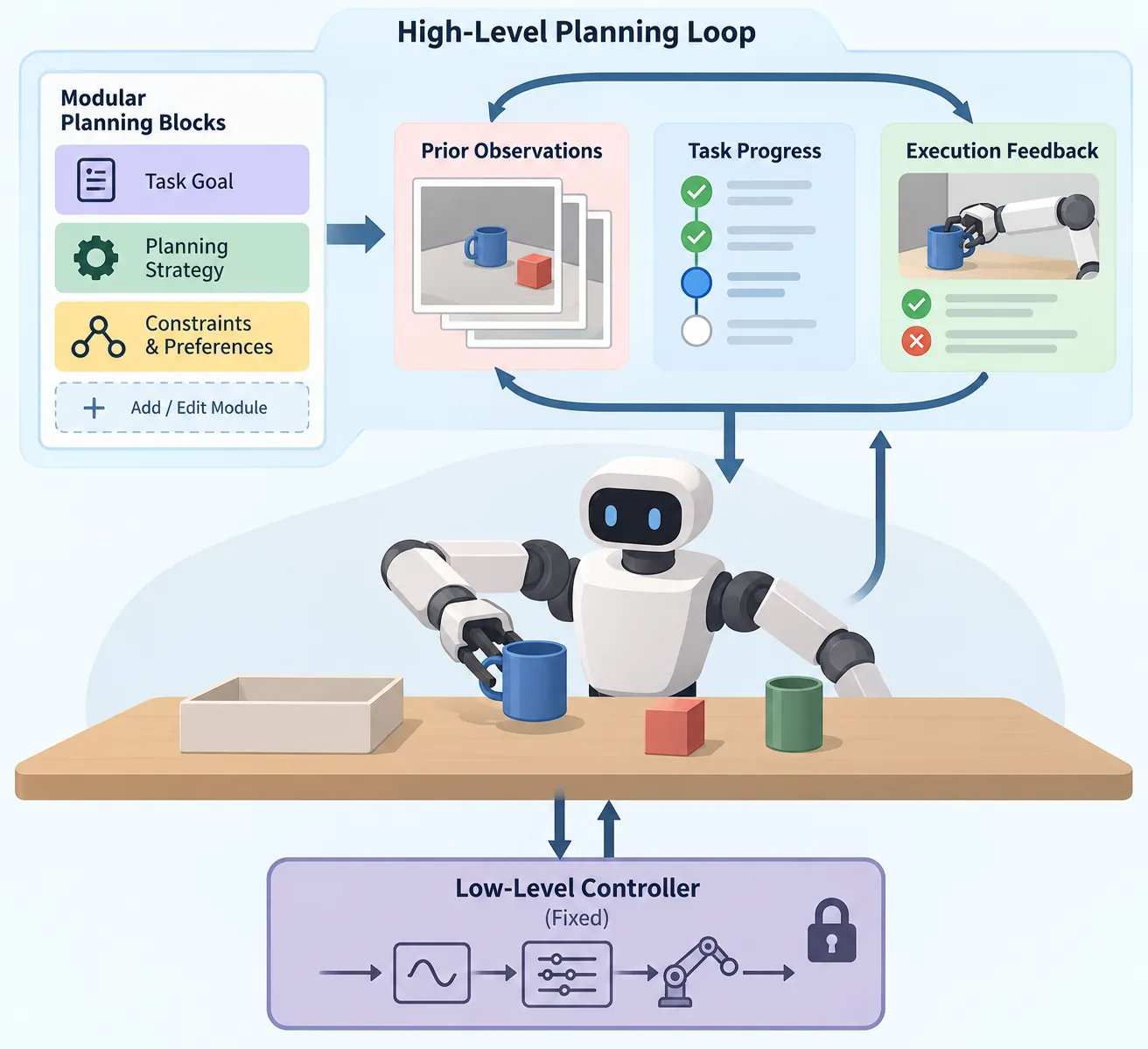
The proposed system separates editable high-level planning from fixed low-level control, then selects harness revisions through environment rollouts before evaluation.
Long-horizon manipulation can be history-dependent: the next useful action may depend on earlier task progress or failed interactions, while the robot may not be able to observe every relevant part of its state. These conditions involve non-Markovian dependencies, while partial observability and execution errors compound over time.
SERA keeps a running task context from observations and execution feedback, uses evaluated environment rollouts to choose revisions to an editable high-level planning harness, and freezes the selected configuration before held-out testing. In the architecture described by the preprint, a high-level vision-language model plans through that harness while a fixed vision-language-action model executes low-level controls. Feedback from execution therefore informs subsequent planning without changing the low-level executor.
The rollouts form a development process rather than continued adaptation during the held-out evaluation: proposed harness revisions are tried in the environment, evaluated, and subjected to autonomous selection before the chosen configuration is fixed. This separation limits the reported test to a selected harness instead of allowing it to keep evolving on held-out tasks.
On RoboMME, the authors report 51.38% overall success with autonomous selection, compared with 44.38% without self-evolution. These are results claimed in the SERA preprint, not independent confirmation; the admitted evidence does not provide further experimental detail needed to assess how broadly the comparison generalizes.