Skills and applications
How can a robot choose a grasp that fits the task?
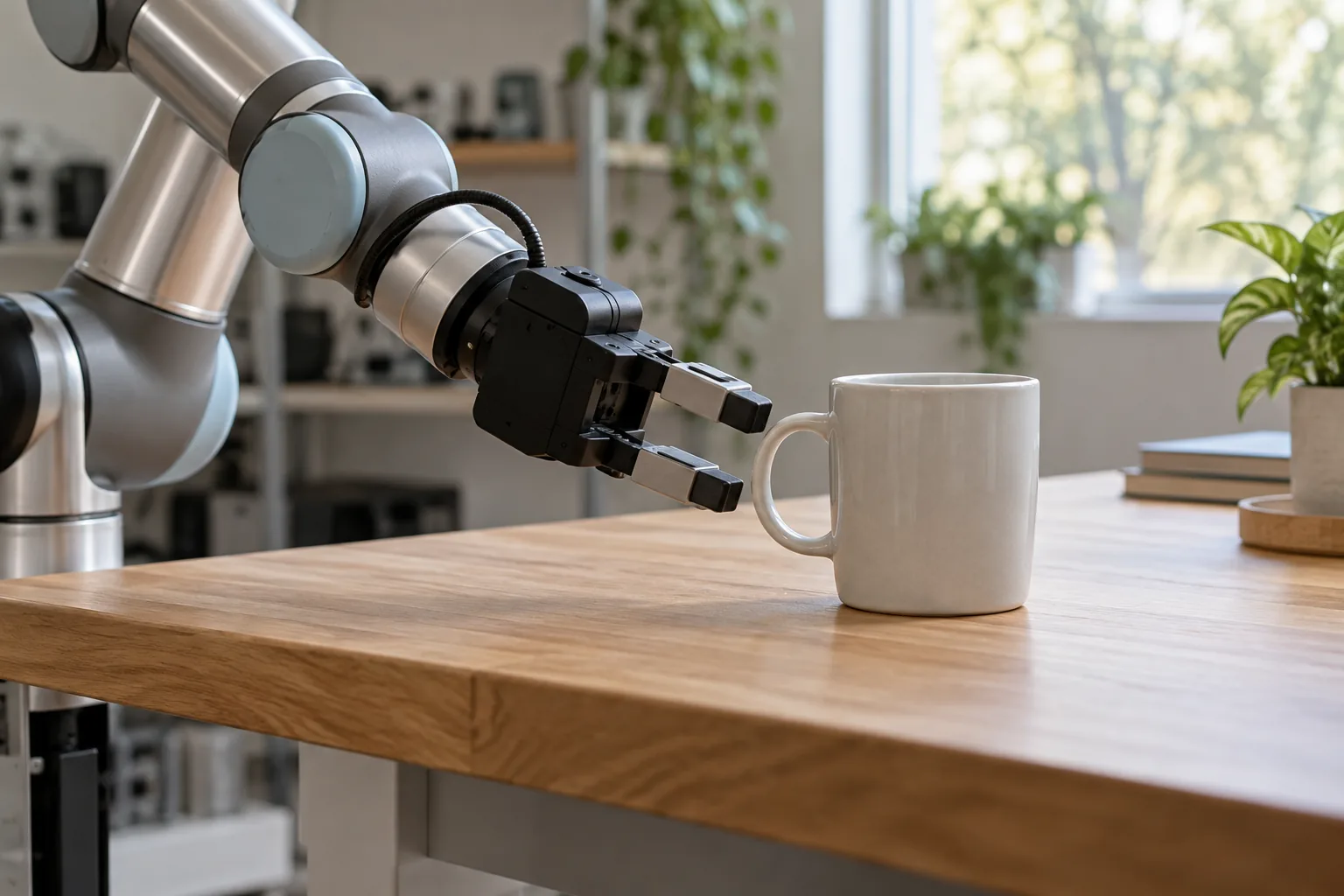
Picking up an object is only part of a useful grasp. For a pouring task, the paper uses a cup handle as an example of a grip that could help the next movement. GraspTwin tests one approach: propose a task-appropriate grip from images, then check in a simulated scene whether the robot can actually make it. The authors test grasps in simulated tabletops and a smaller physical subset; they do not test completion of the whole task.
The question is where and how to hold the object
A task-aware grasp must satisfy several conditions at once: contact with a useful part of the object, a reachable arm pose, and a path that does not strike nearby objects.
In the GraspTwin author preprint, the system starts with a task description and a view from a fixed RGB-D camera. The planner produces a candidate grasp within a larger robot policy, which resumes after the grasp. The experiments score the grasp rather than completion of the entire instruction.
A language model proposes; a simulator checks
The system first reconstructs a rough digital version of the visible scene from the camera image. It renders the target object from several viewpoints so a visual-language model can suggest where to grip it and which side the gripper should approach.
GraspTwin then searches near those suggestions in a physics-based digital twin. Candidate grips are tried with small changes to the modeled object's position and orientation. The simulation checks whether the arm can reach without collision and whether the gripper can lift the object. Its optimization favors proposals that keep working across those modeled changes. Finally, the chosen pose is attempted on the physical arm.
The visual-language model proposes a task-relevant contact point; simulation adjusts the candidate for the arm's reach and nearby obstacles. The paper calls its digital twin an estimate of the environment, so success in it cannot guarantee a grasp on the physical table.
What the comparisons actually show
The authors tested 30 tasks in simulation, with 450 grasp attempts per method. Their overall measure asks whether a grasp is task-appropriate, lifts the object and avoids unintended collisions. In the authors' simulated comparison, the overall grasp-success figures were 51.6 percent for GraspTwin and 33.1 percent for GraspMolmo. These figures do not estimate success in homes.
Using the model's initial proposals without the digital-twin optimization reduced overall simulated success to 22.9 percent. In the other variant, a GraspMolmo pose seeded the optimizer and overall simulated success was 33.8 percent. These tests support the authors' account that both the semantic starting point and the physical refinement mattered in their setup. They do not prove that every other grasping system would benefit in the same way.
In the smaller physical comparison, the authors report 40 grasp trials per method and higher grasp success for GraspTwin than for GraspMolmo.
What “zero-shot” does and does not mean here
Here, zero-shot refers to a grasp on the first real-world trial without in-context demonstrations or real-world training attempts in that setting. The system still depends on existing visual and language models, a known model of the robot, a fixed external depth camera and substantial computation. It also assumes the objects are visible, rigid and ready to grasp without first changing their shape or configuration.
Speed is another practical limit. The authors report roughly five minutes on average from task setup to grasp, much of it spent evaluating simulated candidates in parallel. That timing describes this experimental setup.
So how can a robot choose a grasp that fits the task? In this study, it combines a learned model's idea of where to hold an object with a physics test of whether that hold is reachable and likely to lift it. The result is a specific advance in task-oriented grasp selection under the authors' conditions, not evidence that the robot has learned to perform every task named in its instructions.