Data and benchmarks
When More Human Demonstrations Generally Improve Robot Policies
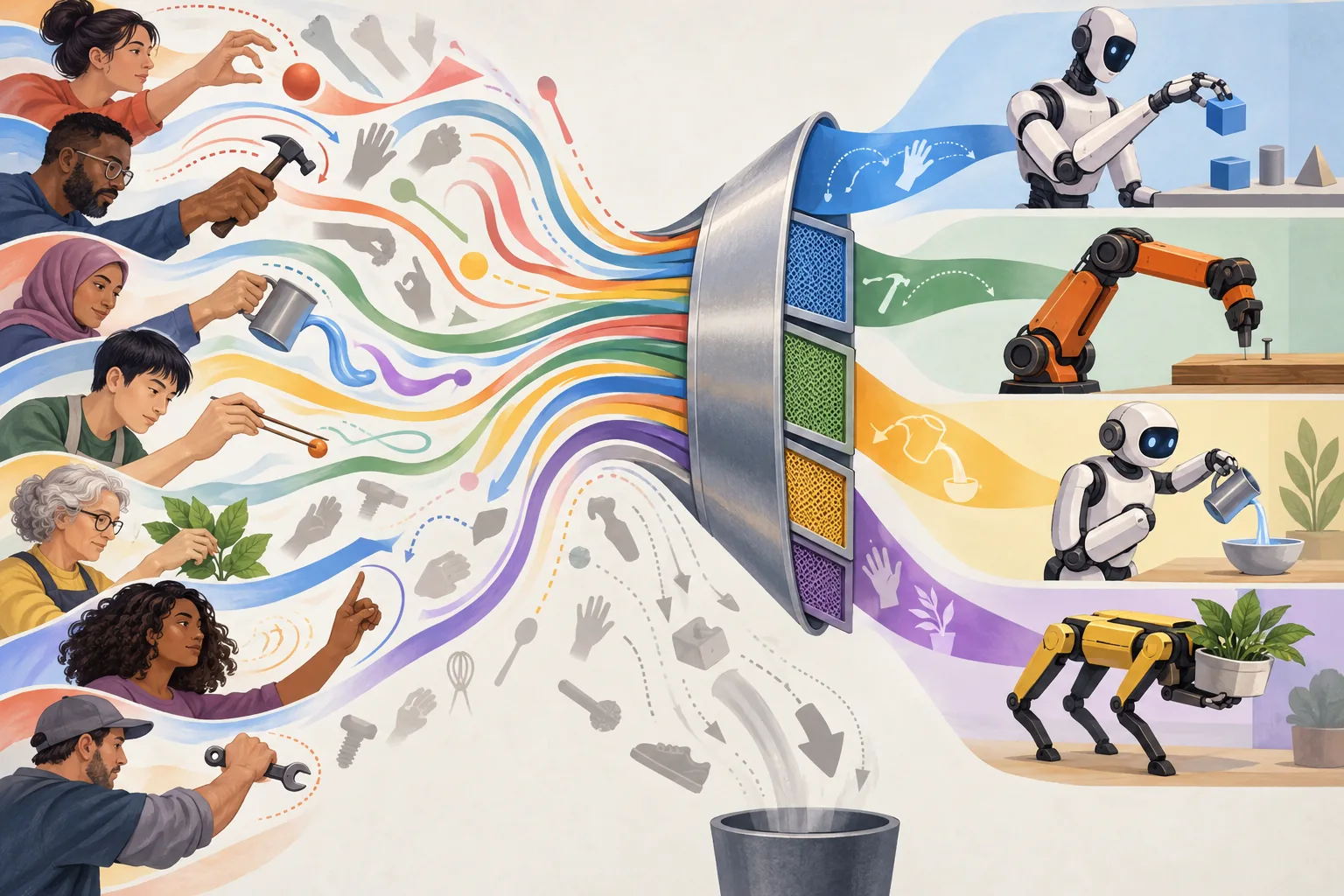
EgoVerse reports a general performance trend across laboratories, tasks and robot embodiments, while making objective alignment the condition for useful data scaling.
The EgoVerse authors report that robot policy performance generally improves as human demonstration data increases, but effective scaling depends on alignment between the human data and the robot learning objectives.
Their human-to-robot transfer study used shared protocols across multiple laboratories, tasks and robot embodiments. Policy performance generally improved as the amount of human data increased, but the available abstract provides no effect sizes or task-level results and does not explain how alignment was measured. The finding is therefore an author-reported trend from these experiments, not independent confirmation of a universal scaling rule.
The current EgoVerse release contains 1,362 hours, or 80k episodes, of human demonstrations spanning 1,965 tasks, 240 scenes and 2,087 unique demonstrators. It includes standardized formats, manipulation-relevant annotations and tooling for downstream learning. Those figures establish the dataset's scale and breadth, but not that every additional demonstration benefits every policy. The supported conclusion is conditional: more data can help when it fits the learning objective, while the abstract does not establish how much is enough or how to identify the demonstrations that satisfy that condition.