Embodied AI models
Action Tokens Need More Than Accurate Reconstruction
A new preprint argues that robot-control vocabularies must combine faithful action reconstruction with tokens a policy can predict and decode robustly.
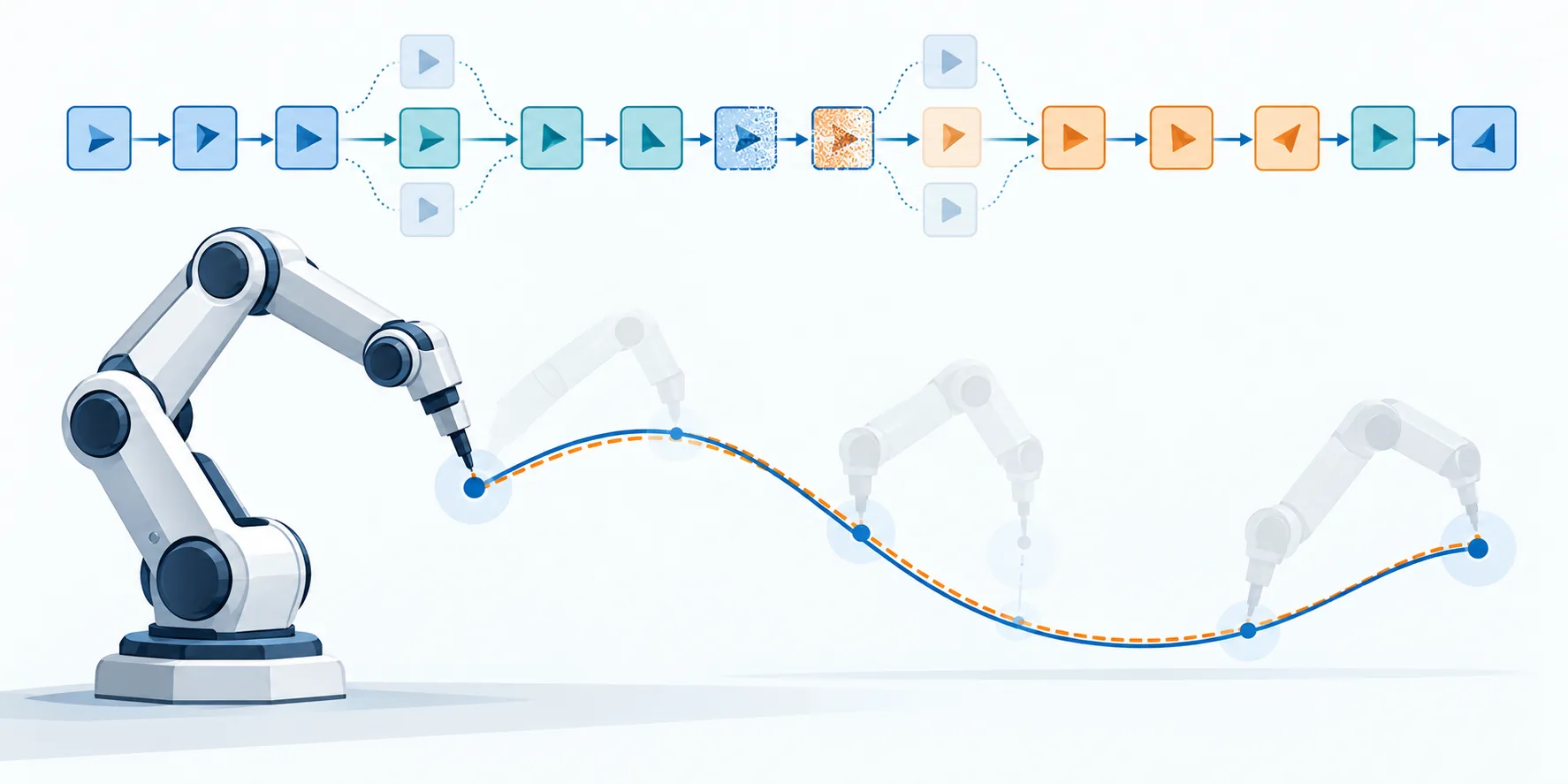
Autoregressive action-token policies use action tokenizers to translate discrete token sequences into precise control actions in continuous space. Many tokenizers learn this mapping through a reconstruction objective, but the preprint argues that accurate reconstruction is only one part of downstream policy success.
Discrete action tokens are useful for robot control when they preserve continuous actions accurately, are predictable from new observations, and decode into reasonable actions even when a policy produces unseen token sequences. The paper states that reconstruction training does not directly incentivize downstream predictability and robustness.
Submitted on October 6, 2026, the preprint introduces Predictable and Robust Action Tokenization, or ProAct. The authors describe ProAct as a policy-agnostic tokenizer training method that strategically augments reconstruction with the goal of improving downstream predictability and robustness. It uses only action datasets for training.
Across Robomimic, LIBERO, and RoboTwin, and over several tokenizer architectures, the authors report that ProAct raised average rollout success by 11.3 percentage points. They also report average gains of 21.8 percentage points for vision-language-action policies and 36.7 percentage points in real-world robotic manipulation. These are results reported by the preprint authors, not independent confirmation, but they support evaluating an action tokenizer as a policy interface rather than on reconstruction accuracy alone.