Embodied AI models
Uni-VLaT Adapts Humanoid VLA Policies With Whole-Body Touch
Uni-VLaT couples distributed touch with future-state prediction; its authors report gains over both touch-free and tactile-input baselines in five physical robot tasks.
A humanoid can make contact outside the camera’s view, leaving vision and joint-state information unable to fully describe the interaction. In a preprint last revised on September 30, 2026, Zihao Wang and co-authors present Uni-VLaT, a method designed to preserve spatially resolved contact patterns from tactile sensors distributed across the robot’s body.
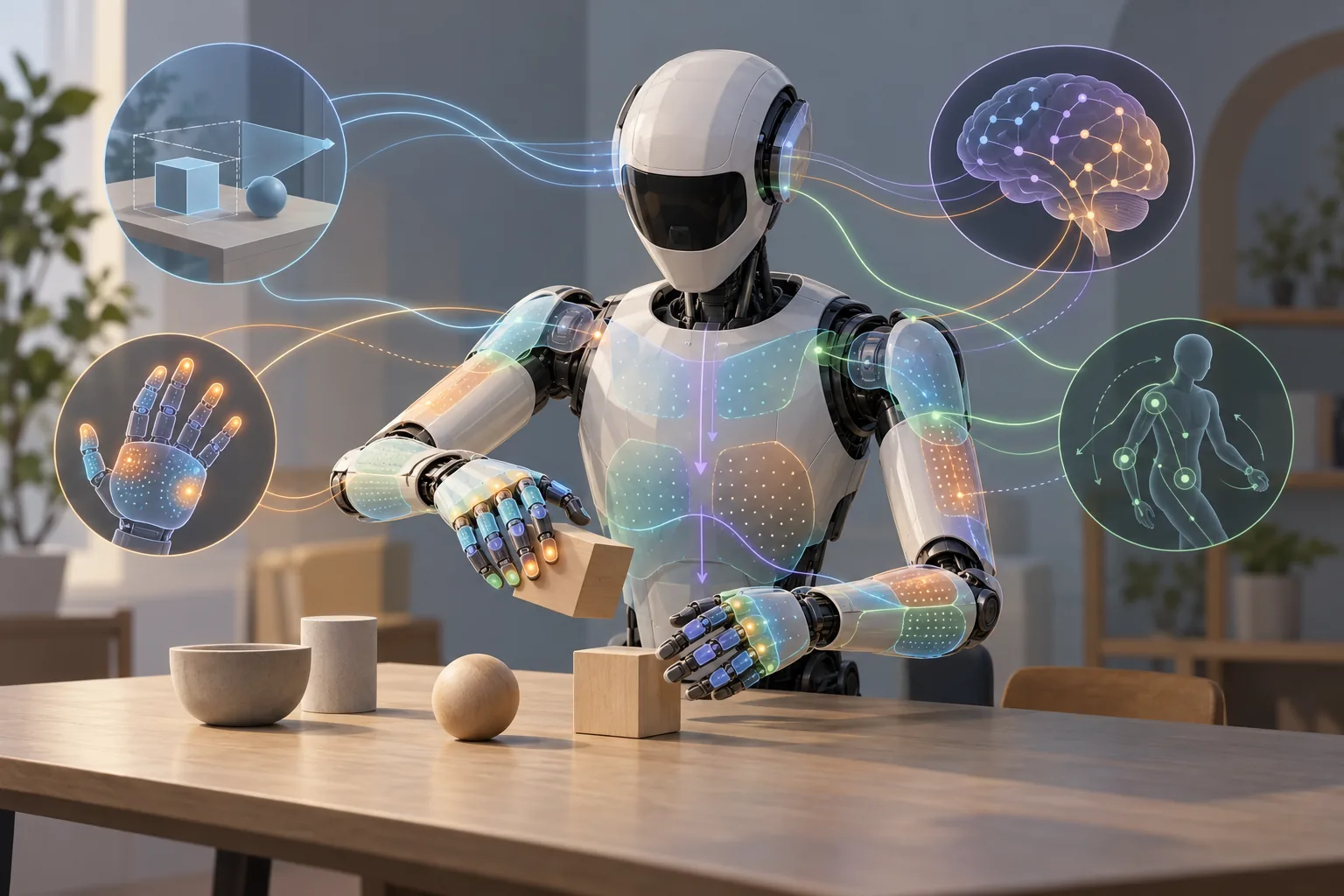
Uni-VLaT adapts a pretrained vision-language-action policy by adding distributed whole-body touch and training its tactile latent state to predict future tactile, proprioceptive, and visual representations as well as actions. The authors describe this predictive objective as a way to build multimodal context around touch, rather than merely supplying tactile readings as another policy input.
The team evaluated the method on five real-robot tasks covering tactile-triggered locomotion, sustained physical interaction, human-robot contact, and loco-manipulation. The authors report a 75% average success rate, 43 points above a baseline without tactile input and 7 points above a tactile-input baseline lacking predictive supervision. In comparisons across two pretrained VLA backbones, they report gains of 30 points for Table Sweeping on each backbone and 85–90 points for Back-Tap Walking.
Ablations reported in the paper identify contextualized tactile prediction and absolute future targets as critical components. Together with the 7-point advantage over tactile input alone, this supports the authors’ narrower claim that predictive supervision contributed beyond sensor access in their setup. The evidence comes from a single author preprint, however, so the reported results establish performance in its five-task evaluation rather than independent validation or broad superiority across humanoid contact tasks.