Data and benchmarks
Replay Archive or Structured Demonstrations?
A practical comparison of the two 20,000-demonstration releases, including their formats, intended operations, visual data, and storage footprints.
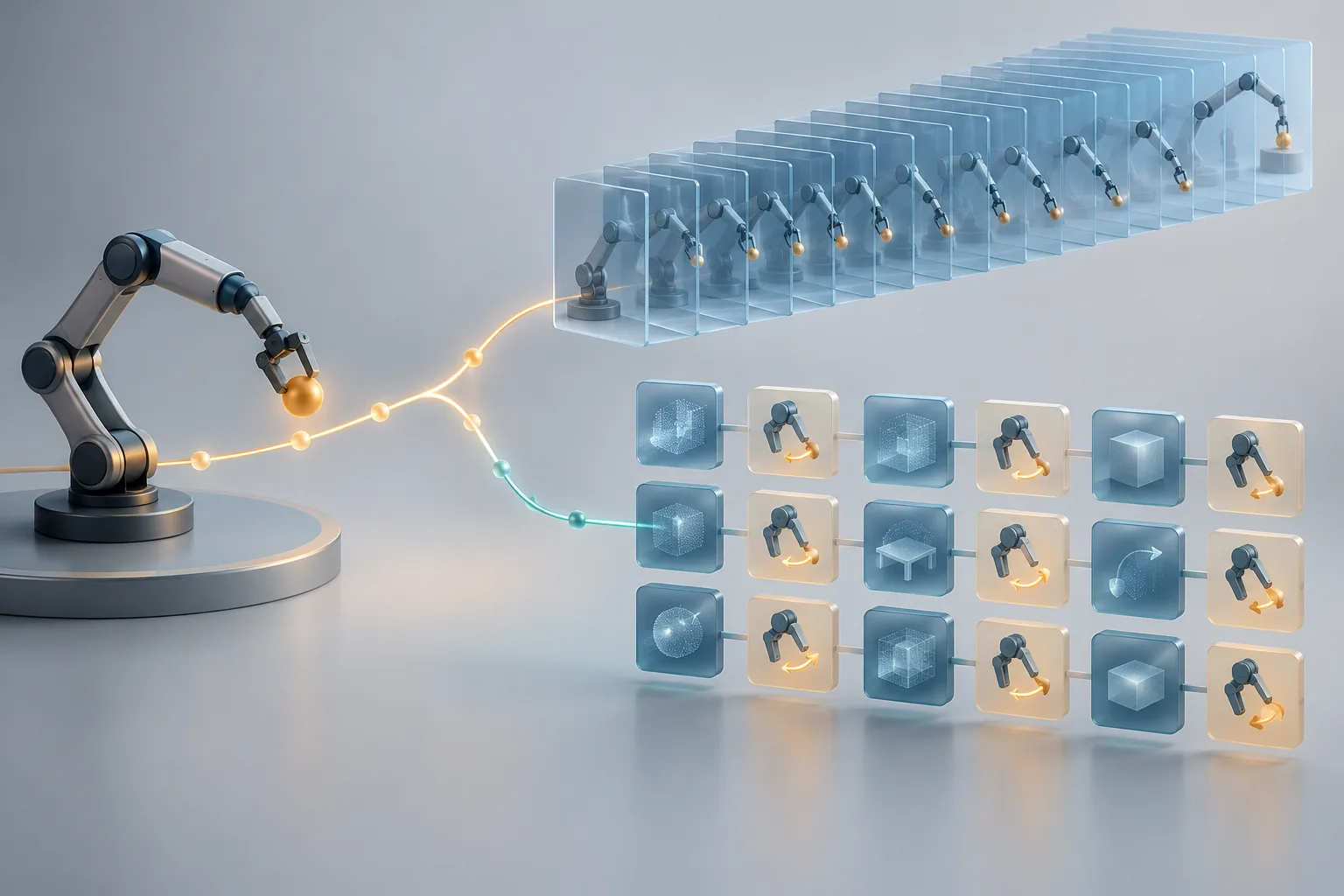
Raw HDF5 data preserves what OmniGibson needs to reproduce the recorded trajectories and generate more visual observations, whereas the LeRobot dataset packages human teleoperation demonstrations in a defined dataset format with specified visual modalities.
2026-challenge-rawdata contains the original raw HDF5 data for 20k teleoperation demos and totals 1.44 TB. The files contain everything needed to replay exact trajectories in OmniGibson. With OmniGibson's replay_obs.py script, they can also be used to collect additional visual observations during replay.
By comparison, the source describes 2026-challenge-demos as 20,000 human-collected teleoperation demonstrations spanning 100 tasks. This 3.27 TB collection follows LeRobot V3 with customizations for better data handling. Its documented visual modalities are RGB and linear depth: RGB uses numpy.uint8 values from 0 to 255, while depth uses numpy.float32 values from 0 to 10 meters and is log-quantized during replay before being converted back to metric depth values. Camera resolutions also differ by viewpoint, at 720 × 720 for the head camera and 480 × 480 for wrist cameras.
The choice depends on the operation required: use the raw HDF5 files when exact OmniGibson replay or collection of further visual observations is necessary, and use the LeRobot version when the demonstrations are needed in its documented dataset structure. Both represent the same stated scale of 20,000 demonstrations, but their storage footprints and immediate purposes differ.