Learning methods
One Learning Loop for Robot Orchestration and Action
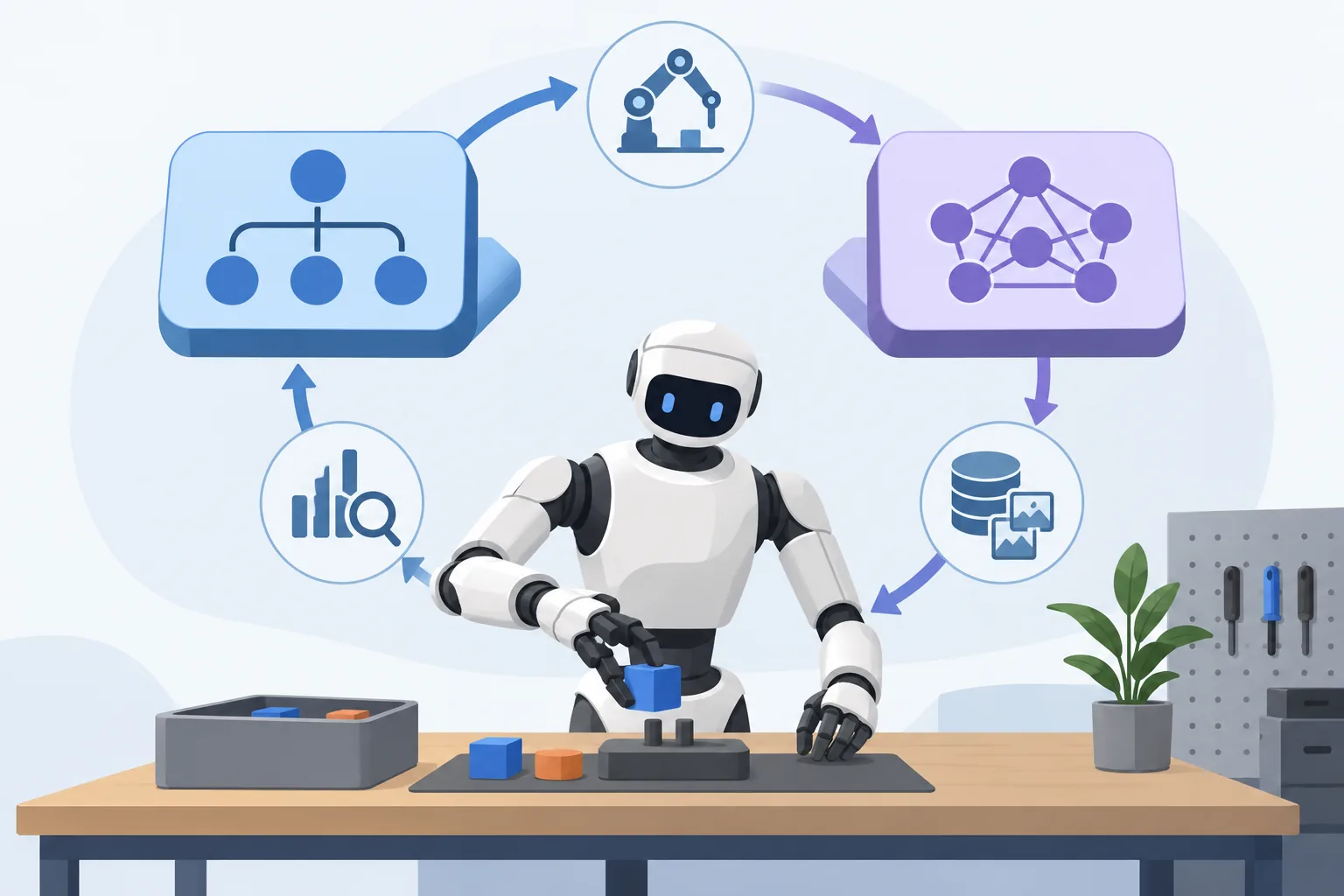
Robo-COP uses experience gathered during operation to target repeated failures, retrain the underlying controller, and test revised skills before accepting an update.
A robot’s orchestrator and action policy can improve together when deployment becomes a controlled feedback loop: executions supply curated demonstrations, recurring failures inform policy fine-tuning, and a candidate policy is adopted only after it improves the skills it was trained to repair. Robo-COP is the authors’ proposed implementation.
With a frozen policy, the orchestrator can route around failures but cannot eliminate them, leaving the policy as a bottleneck. Updating the policy alone can create a different mismatch because the orchestrator was tuned to the policy’s previous behavior. Robo-COP instead curates skill demonstrations from its own executions, fine-tunes the policy when those data can address recurring failures, and verifies the targeted skills before accepting the revised policy.
Across ten simulated RoboLab tasks, the authors report that Robo-COP increased mean held-out success from 64.8% to 73.8%, compared with the same orchestration system using a frozen policy. Fine-tuning on a fixed schedule without verification reached 65.8%. On three physical tasks, they report an increase in held-out success from 38.3% to 50.0%.
These figures come from the authors’ primary research report, not an independent confirmation. The available abstract gives aggregate success rates but does not describe task-level procedures, trial counts, uncertainty, or outcomes beyond the evaluated tasks. The evidence therefore supports a narrower conclusion: in the reported settings, coupling deployment data, targeted policy updates, and skill verification performed better than the stated frozen-policy and unverified-update baselines.