Embodied AI models
How PhoneBot Builds a Humanoid Around a Smartphone
The proposed open platform pairs a modular lower body with 13 low-cost actuators and a torso-mounted phone that handles perception, control, communication, and interaction.
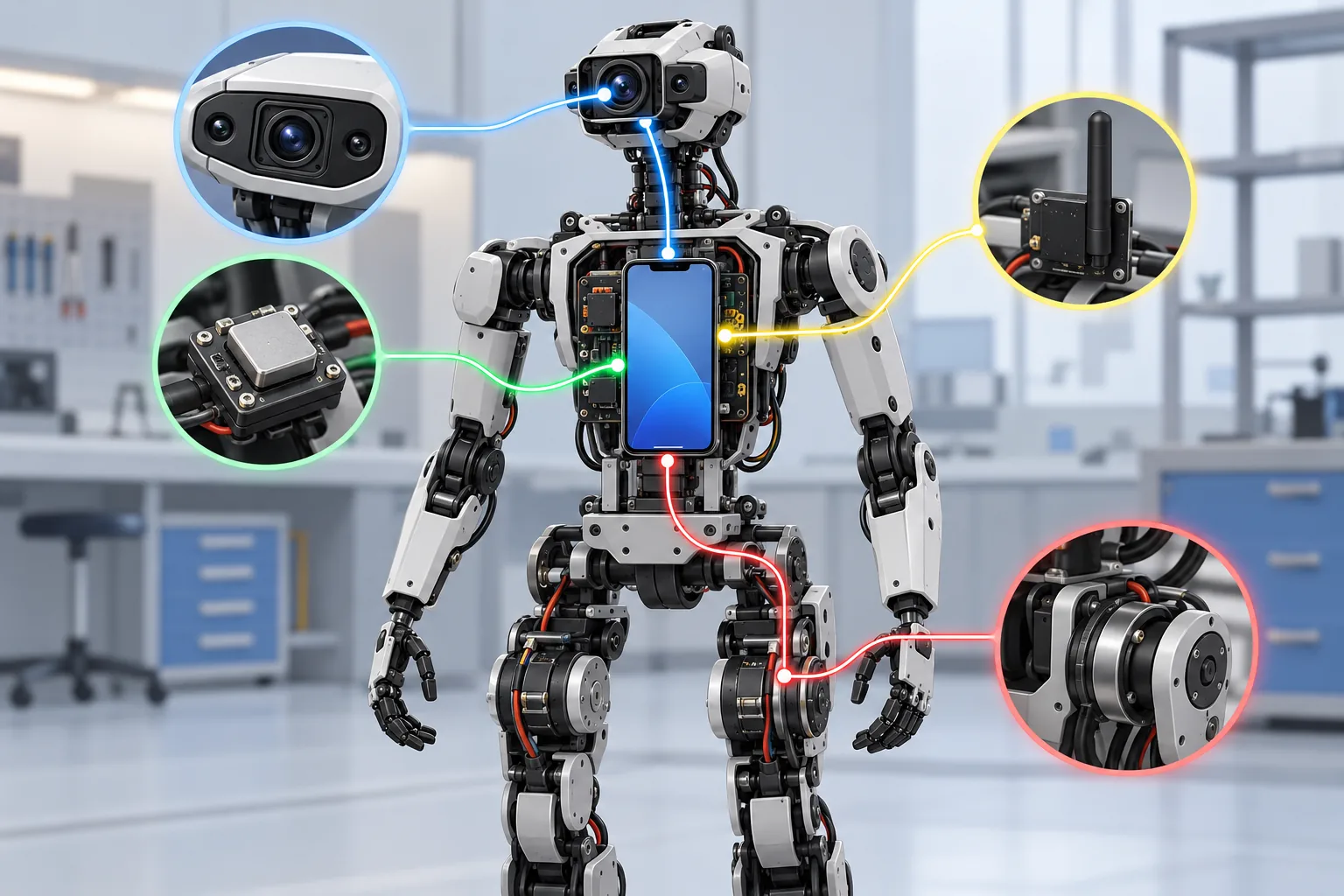
PhoneBot’s proposed architecture centers the robot on hardware already integrated into a consumer phone. A torso-mounted smartphone serves as PhoneBot’s primary sensing and computing unit, combining its camera, inertial measurement unit, wireless connectivity, and onboard processing in one device. The phone supports perception, control computation, and user interaction, while a modular lower body provides 13 low-cost actuators.
The camera supplies visual input, and the inertial measurement unit, or IMU, provides built-in motion sensing. The preprint’s authors describe a real-time communication framework that uses the phone’s connectivity alongside its local processing. This arrangement is intended to simplify the system architecture and reduce hardware costs by concentrating several sensing, computing, and communication functions in the smartphone.
The authors report stable locomotion, vision-based human following, conversational interaction, filming, and mobile telepresence. They also claim reliable walking, perception-driven interaction, and straightforward deployment with off-the-shelf smartphones, but the supplied abstract does not give evaluation protocols, numerical performance results, phone models, or a hardware price. PhoneBot’s affordability and reproducibility therefore remain claims from its authors, supported here by a single preprint abstract rather than independent confirmation, although the described open-source hardware and software provide a stated route for others to reproduce and examine the platform.