Embodied AI models
How One Humanoid Policy Learns to Handle Different Objects
The I-BFM authors say one policy learns shared interaction dynamics and uses latent commands tied to downstream rewards, with short- and long-horizon targets.
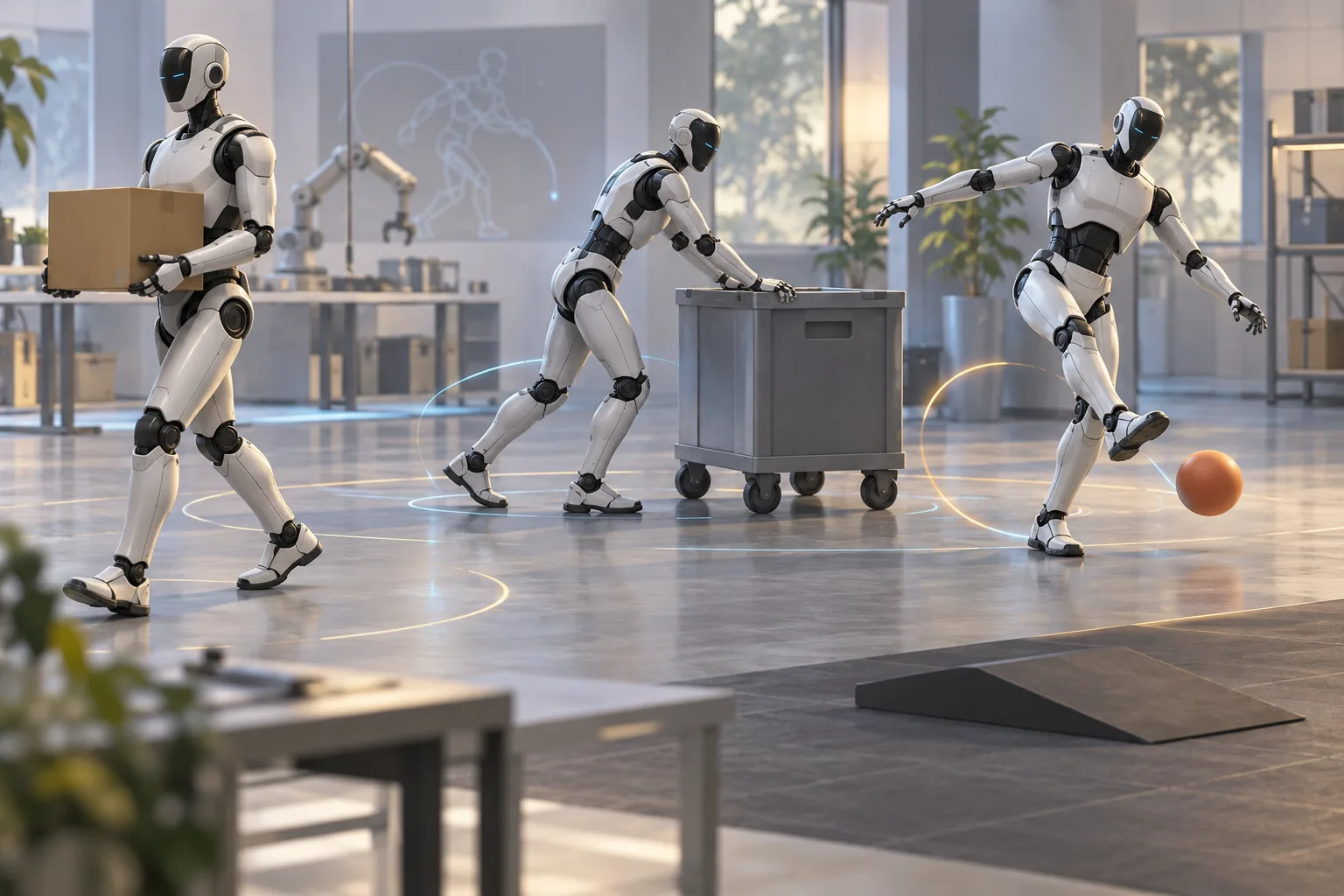
A humanoid that carries a box, pushes an object or kicks a ball must coordinate its body with objects and changing contacts. The I-BFM authors address this as one learning problem: their model uses unsupervised reinforcement learning to capture the coupled dynamics of the humanoid, objects and contacts in a shared representation.
I-BFM avoids task-specific retraining by learning shared humanoid, object and contact dynamics, then conditioning the same policy on a latent command associated with a downstream reward. The researchers train the policy with short-horizon interaction targets and longer-horizon goal targets. They report that the single policy performs carrying, pushing and kicking, while also supporting goal reaching, motion tracking, stylistic control and long-horizon task chaining.
On the Carry task, the authors report 94.3% nominal success and 89.3% success after robot falls; a planning-based baseline achieved 1.3% after falls. These are results reported by the preprint’s authors, not independent confirmation.
Experiments with a real Unitree G1 demonstrate varied locomotion-and-manipulation behaviors, recovery from interaction failures and external disturbances, and task chaining without task-specific retraining.