Embodied AI models
Can a learned robot gait work on a different body?
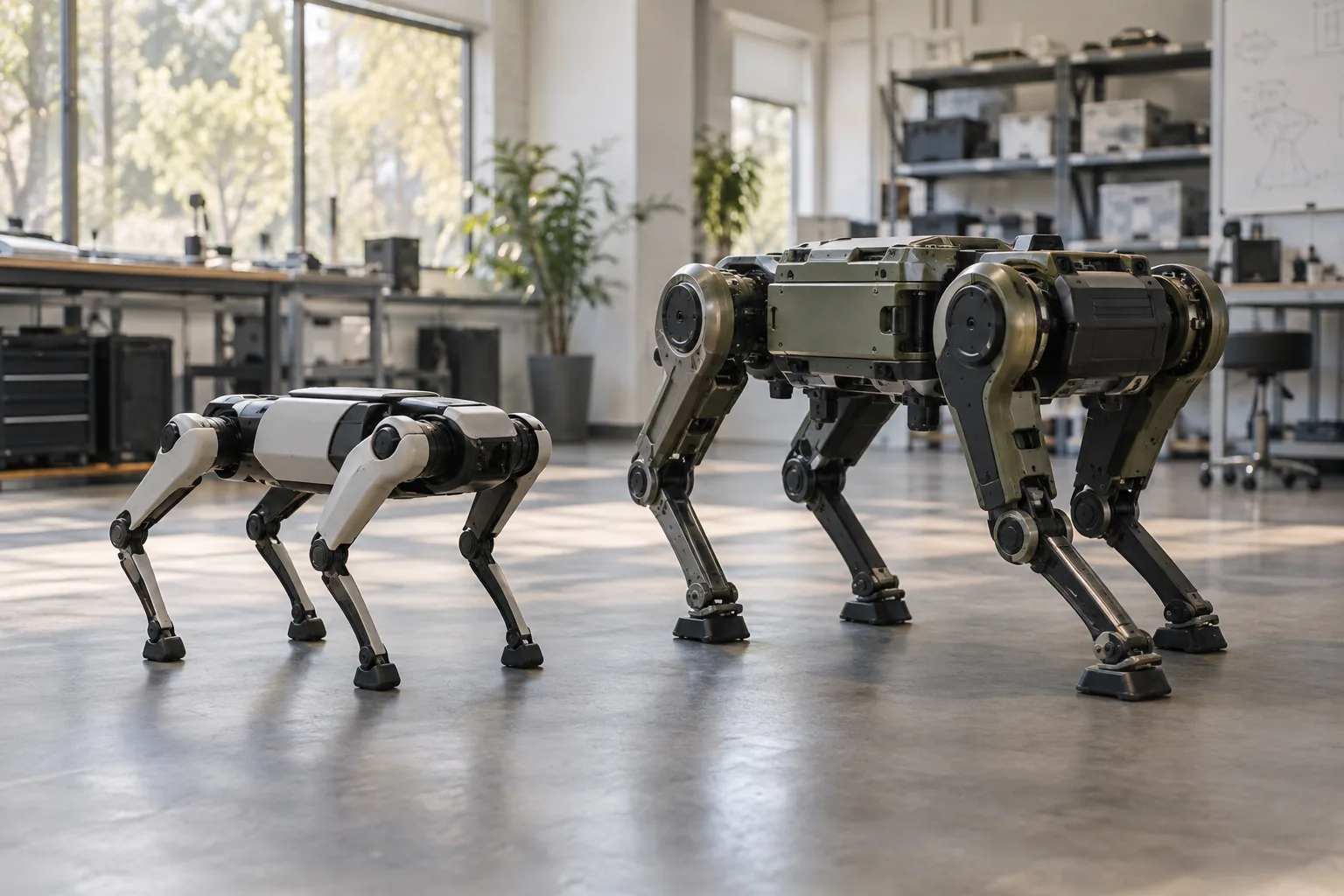
MorFiC's walking policy worked better on some tested quadrupeds than on others, and the authors also tried it on physical Go1 and Go2 robots. The answer is conditional: a learned gait can transfer within part of this tested range, but the study does not show one policy walking reliably on every robot.
What did the researchers transfer?
The MorFiC author preprint describes training from a single Go2 source template. The researchers then evaluated the trained policy on other quadruped models without training a separate policy for each target.
Here, zero-shot transfer refers to evaluation on a target body without further policy training or fine-tuning for that target. The policy had still undergone simulation training, and its controller received information about the target's physical properties. The result therefore tests reuse across bodies under a defined setup, not learning to walk without prior training.
What does the policy know about the body?
MorFiC uses a compact description containing link masses and joint limits. The authors focus on the critic because they argue that one shared value estimate can blur differences between robot bodies. Their comparisons test whether conditioning that estimate on the body improves transfer.
This is the mechanism the paper investigates. The comparisons test whether it improves transfer in the authors' setup. They do not establish that every failed transfer has the same cause, or that masses and joint limits describe every difference that matters on hardware.
How was transfer judged in simulation?
The paper's simulated comparison reports both achieved forward speed and survival. In that simulation, survival is the share of runs that reach the chosen time limit without early termination. The authors warn that a controller can survive while moving too little to count as a useful gait. Reading a survival score without speed would therefore give an incomplete picture.
AlienGo is a favorable case in the authors' comparison. Under their simulated test, MorFiC-F reached 1.98 metres per second, while the compared additive PPO variants stayed below 0.65 metres per second. The same row also reports survival through the simulated test. These are results from the paper's test conditions, not a measured speed for a physical AlienGo or a ranking of all walking methods.
B1 shows a limit of the same study. It remained non-terminated in the simulated test but made little forward progress; the authors did not regard that as a useful gait. The successes on some targets cannot be extended to every body in the comparison.
What happened on physical robots?
The researchers report deploying the same policy weights, without target-specific fine-tuning, on physical Go1 and Go2 robots. For Go1 they report roughly 1.4 to 1.7 metres per second across ten trials, with more than 80% of runs avoiding a freeze or gait failure. They report roughly 1.1 to 1.3 metres per second on Go2. The broader table of target models is a simulation result.
The authors also report latency and state-estimation problems during deployment. A successful trial shows the controller ran in their setup. It does not establish long-term reliability, performance on every surface, or transfer to a substantially different kind of robot.
Where is the boundary?
Increasing the range of body variation during training did not resolve the B1 failure in the authors' additional test. Their study concerns quadruped locomotion; bipeds, humanoids and other skills remain outside its demonstrated scope.
MorFiC offers evidence that using body information during learning can help a walking policy transfer to some other quadrupeds. The B1 result and the limited hardware trials make the boundary equally important: the method should be judged by useful movement on each target, not by the word zero-shot or by survival alone.