Data and benchmarks
Successful Variety Matters in Robot Demonstration Data
The DiscoDemo preprint illustrates how success-gated generation, safety filtering and static export can add multiple valid solution modes to imitation-learning data.
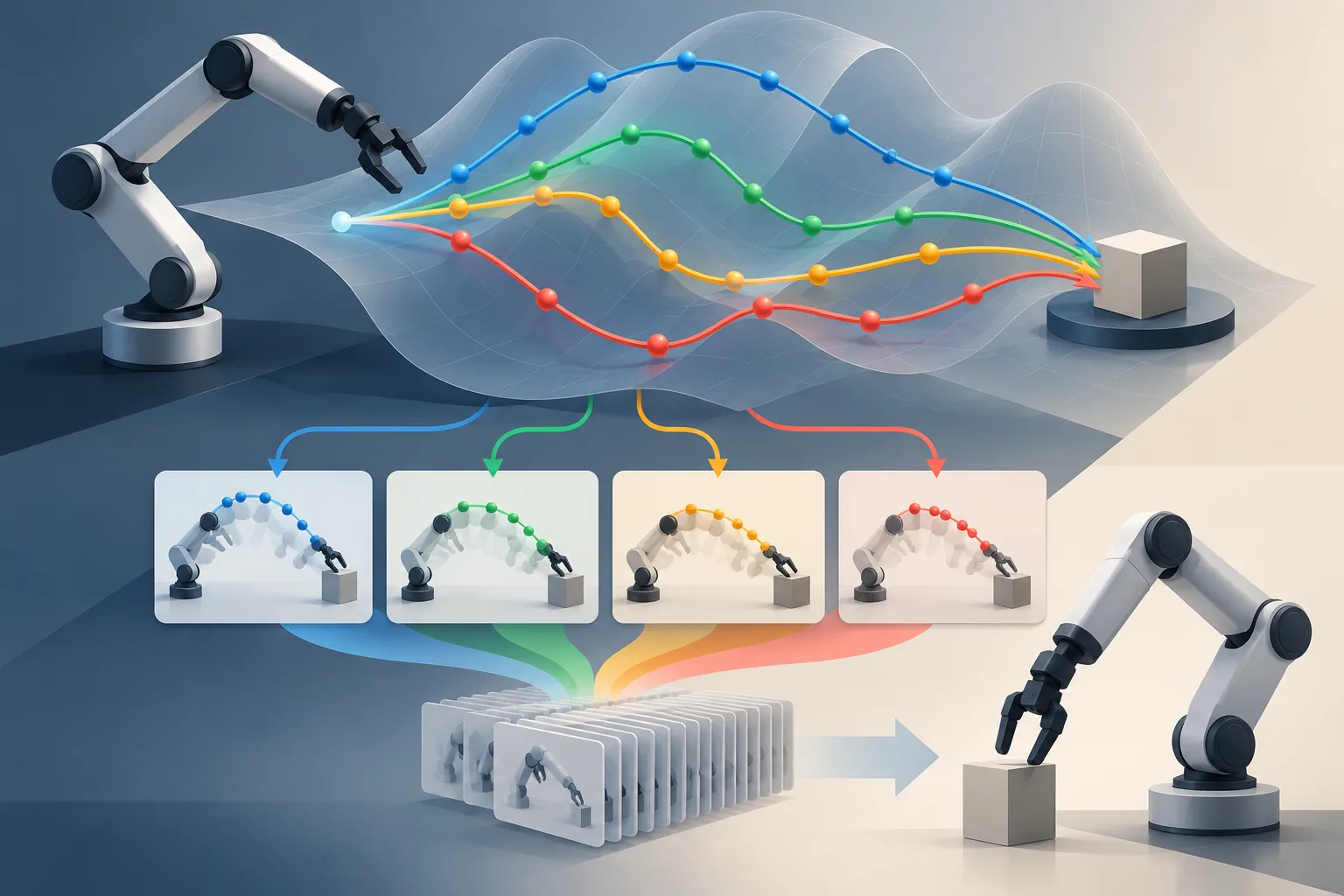
A demonstration set can contain many examples yet remain narrow when they repeatedly represent the same way to complete a task. Diverse successful trajectories can improve an imitation-learning dataset because they cover a broader range of successful states and solution modes than repeated examples of one narrow solution. The relevant distinction is therefore variety within successful behavior, not demonstration volume alone.
The DiscoDemo preprint presents one mechanism for producing that variety. It uses reinforcement learning as a data generator rather than as the deployed controller. A privileged, latent-conditioned generator combines a parallel reverse curriculum with an objective that rewards diversity only when success is preserved. Its multiple successful closed-loop behaviors are then safety-filtered and exported as a static dataset for training a visuomotor imitation policy.
Across four manipulation tasks, the authors report broader successful-state coverage and higher downstream success. Averaged across tasks in simulation, success reached 62%, compared with 40% for the strongest baseline. On a physical robot, they separately report 78%, compared with 39%. These figures are results claimed by the authors of one preprint, not independent confirmation.
The admitted abstract does not provide enough experimental detail to determine how the effect of trajectory diversity was separated from demonstration volume or from the other components of DiscoDemo. It nevertheless supplies a concrete account of why coverage matters and presents diverse successful data as complementary to corrective data collection, rather than as its replacement.